by Francesco Paolo Sgarlata |
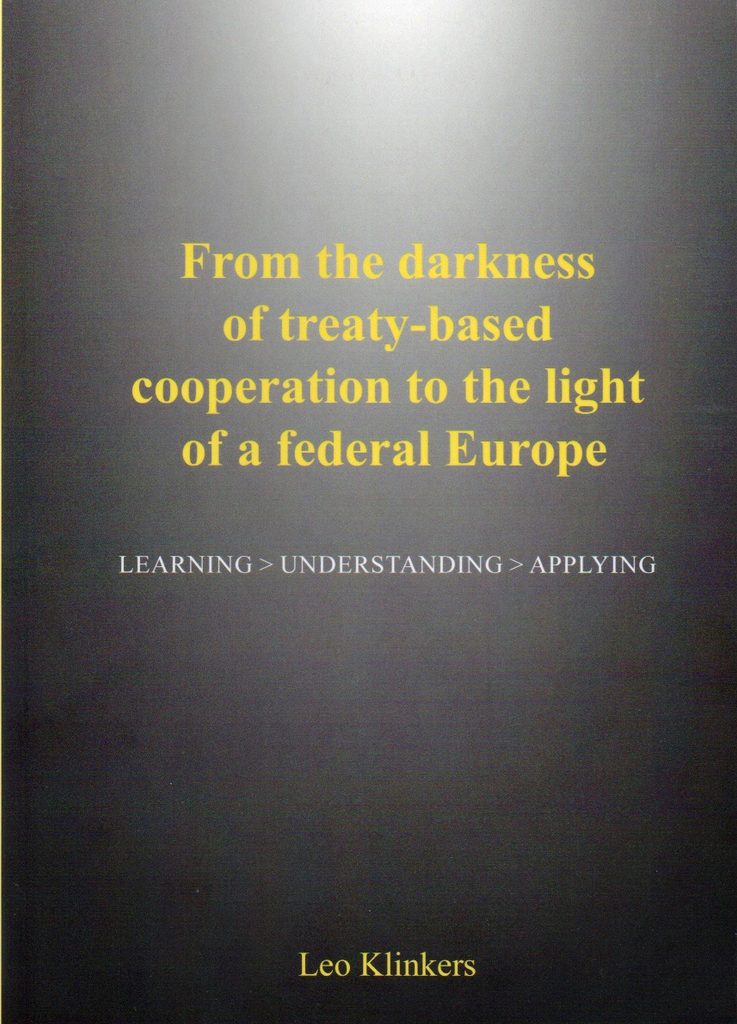
As the European Union faces mounting geopolitical pressures, democratic deficits, and internal friction, political analysts and citizens alike are questioning whether current institutional mechanisms remain fit for purpose. In his seminal work, From the Darkness of Treaty-Based Cooperation to the Light of a Federal Europe (June 2026), Leo Klinkers delivers a rigorous, multidisciplinary diagnosis of the European crisis and outlines a compelling blueprint for institutional rebirth. Far from a mere political polemic, Klinkers’ work positions itself as a foundational text for the construction of a genuinely democratic, federal Europe.
The Core Thesis: A Systemic Crisis, Not an Incidental Stumbling Block
Klinkers argues that the current troubles facing the European Union—ranging from political fragmentation and administrative inertia to rising autocratization and declining public trust—are not isolated mishaps. Rather, they are symptoms of a political model that has reached the end of its evolutionary lifecycle.
The primary structural flaw identified in the book lies in the EU’s foundational mechanism: multilateral treaty-based cooperation. Unlike state formations built on constitutional legitimacy directly granted by citizens, the EU operates as a complex web of treaties among sovereign nation-states. When crises arise, national self-interest routinely overrides common solutions, and endless treaty amendments act as temporary bandages rather than permanent fixes.
Drawing on Polybius’ ancient theory of Anacyclosis (the cyclical rise, degeneration, and renewal of political systems) alongside modern systems theory and the Second Law of Thermodynamics (entropy), Klinkers demonstrates scientifically how political systems decay when they lack self-correcting negative feedback mechanisms. The current treaty-based regime is consuming ever-increasing amounts of energy simply to maintain its status quo while yielding diminishing returns in governance and stability.
Historical Foundations: The Thought of Johannes Althusius
A cornerstone of Klinkers’ argument is the political philosophy of Johannes Althusius (1563–1638), a German jurist widely regarded as the father of modern federal doctrine.
To move beyond the systemic failures of treaty-based governance, Klinkers revisits Althusius’ principle of consociatio—the bottom-up creation of political order. Key insights derived from Althusius emphasize a bottom-up order, or centripetal state formation, where sovereignty originates not with central rulers or state machinery, but with organic human communities—families, municipalities, and provinces—working together voluntarily to create a higher authority without surrendering their own core autonomy. Furthermore, his framework relies on shared sovereignty and subsidiarity, ensuring that higher levels of governance complement lower levels only where necessary, preserving local self-determination while coordinating shared needs. Ultimately, this creates a stewardship of power in which rulers do not “own” authority; rather, they hold a temporary mandate to serve the common good, subject to institutional accountability and checks and balances.
By contrasting Althusius’ federal model with the current EU structure—which Klinkers terms a regime of “treaty-based anarchy”— the book establishes that true stability requires replacing state-centric treaties with a citizen-legitimized constitution.
The Three Pillars: Learning, Understanding, Applying
The overarching structure of Klinkers’ work provides a pragmatic methodology for European renewal, articulated through three sequential steps:
- Learning: Recognizing that political systems undergo predictable lifecycles of rise, decay, and transformation, as shown by historical scholars like Polybius and Althusius.
- Understanding: Grasping that the European Union’s inherent design flaws—namely its lack of a direct constitutional basis and democratic coherence—cannot be solved by continually patching an obsolete treaty framework.
- Applying: Actively engaging in a new era of Enlightenment to construct a federal state system—the fourth major European state system since the Common Era—capable of securing peace, justice, and prosperity for over 800 million citizens across continental Europe.
A Constitution for the Future
Crucially, Leo Klinkers moves beyond theoretical diagnosis to offer a concrete constitutional framework. The book features a concise 10-article democratic federal constitution for Europe, drafted by a Citizens’ Convention under the auspices of the Federal Alliance of European Federalists.
This streamlined constitution demonstrates that a federal Europe does not mean establishing an overbearing superstate. Instead, it creates a transparent, multi-layered government with clear division of powers, robust checks and balances, and direct democratic legitimacy.
A Call to Courage
From the Darkness of Treaty-Based Cooperation to the Light of a Federal Europe arrives at a pivotal juncture in European history. As power blocs consolidate globally and geopolitical risks intensify, a fragmented Europe remains inherently vulnerable.
Leo Klinkers reminds us that major institutional shifts throughout history—from the United States to the federal systems of Switzerland, Germany, and Belgium—have always emerged out of deep crisis. The creaking of the European Union today should not be feared as a sign of imminent doom, but welcomed as the necessary catalyst for historical transformation. For scholars, policymakers, and engaged citizens alike, Klinkers’ work serves as an indispensable roadmap toward a federal future.